Activism makes a difference: the SCREEN Act unexpectedly fails in committee! But KOSA advances, so keep up the pressure
The best way to build on this victory is to keep the pressure on with KOSA and other bad internet bills.

"Even if the committee votes to advance one or more of the bills (which they probably will), there will be other chances to block them. Still, that'll only happen if we keep the pressure up. The more noise we make around this battle, the more likely it is that they'll decide not to prioritize these bills over the rest of the year. And the more strength we can build with our organizing over the next few days, the better our position will be for whatever showdowns happen later in the session and next year."
– “The S is for surveillance”: fighting KOSA and bad internet bills in the ATmosphere and the fediverses, August 2
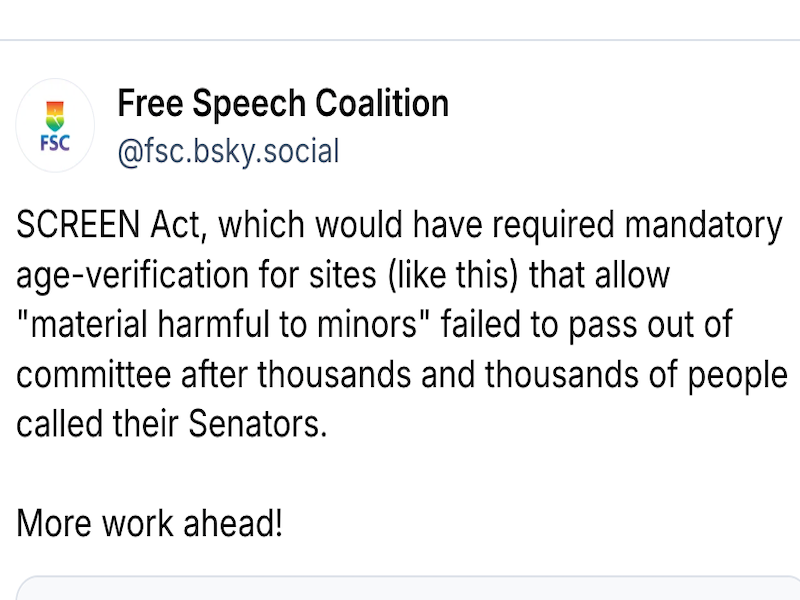
Wow, I wasn’t expecting that! After the Senate Commerce Committee‘s roll-call vote on the odious SCREEN Act age verification bill (15-13 along party lines), Ranking Member Cantwell casually mentioned that there weren’t enough members present in person. Chair Cruz agreed, and noted that as a result the bill would not be reported out. And then the committee went on to other bills, including KOSA (the Kids Online Surveillance Act) and the CHATBOT Act, advanced them all on voice votes, gave a few speeches, and the hearing was done.
As you can see from my live-skeeting, at first I wasn’t sure how significant this incident was. Maybe it was just a minor procedural issue that they‘d be able to address quickly? Nope!
The consequences are just the same as of the vote didn’t happen, or if it had gotten voted down. It’s just that this way, Republicans don’t have to vote against the bill. As Evan Greer of Fight for the Future says (in a thread with some great perspectives on the hearing) “master classes in bravery we're seeing here.”
But hey, whatever works. As Mike Stabile of Free Speech Coalition says,
“The bill isn't dead, of course — it can be brought back before the end of session — but given today's lack of engagement on it, that seems less likely than it would have even a few days ago.”
So thanks to everybody who took action! The day before the vote, we expected Republicans to all support it and were concerned that some Democrats would as well. The thousands of phone calls and emails clearly had an impact, and led to an unexpected victory. Huzzah!
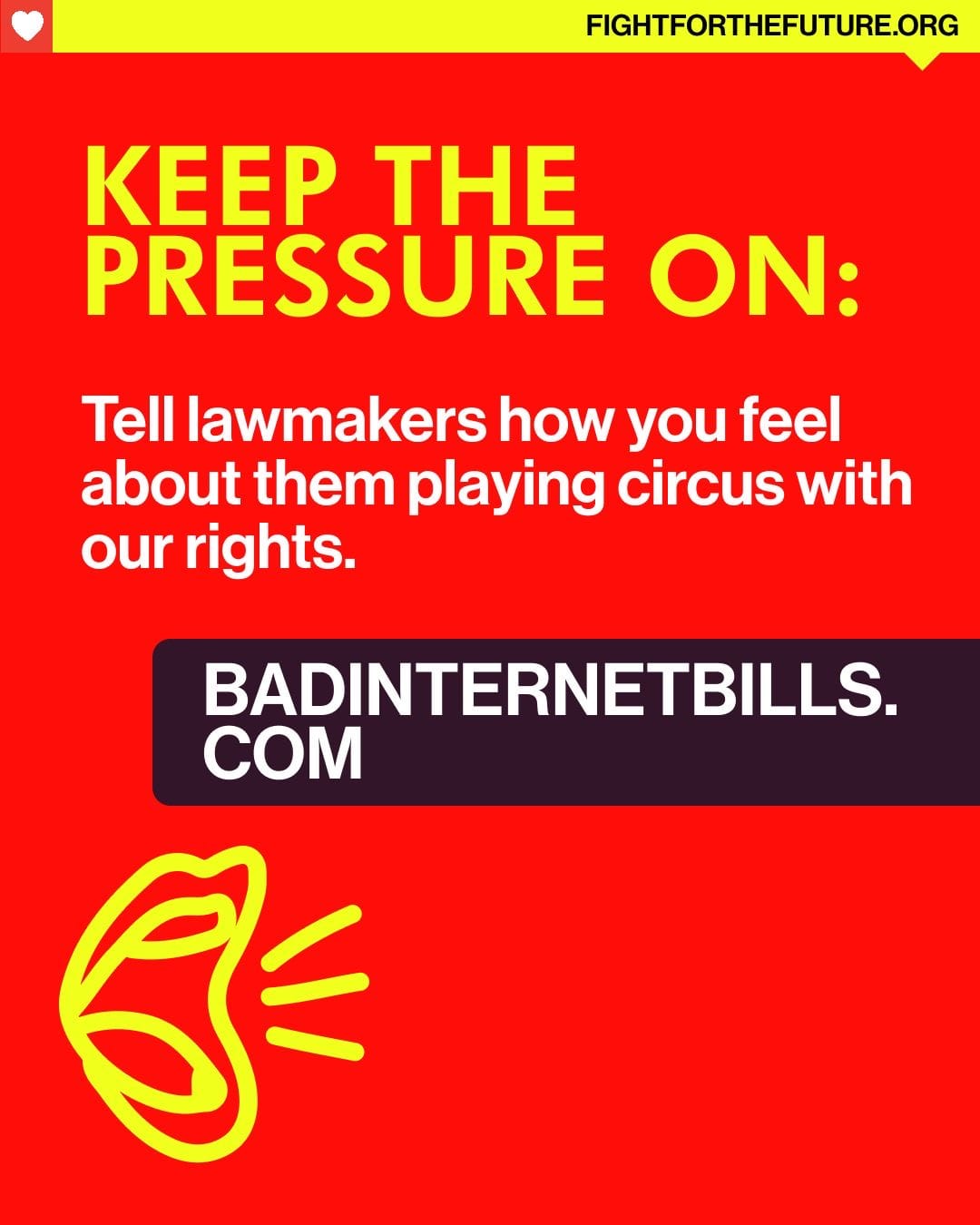
And the best way to build on this victory is to keep the pressure on with KOSA and other bad internet bills. The House and Senate versions of KOSA are very different, and legislators have a lot of stuff on their plates … they might well decide it’s not the best use of their time to try to come up with a version that can pass both chambers. The louder we are now, the less likely it is that KOSA will pass. And while the SCREEN Act was arguably worse, KOSA is still pretty bad.
“Despite the usual and continued insistence that KOSA protects kids, the duty of care enforced by a Trump FTC would be a censorship and surveillance nightmare, especially for LGBTQ+ youth who need online communities now more than ever to connect, organize politically, and find resources that are being restricted in public space by the Trump administration and rightwing state governments.”
— Fight for the Future’s press release after the vote
So if you're in the US, please contact your Senators – whether or not you've already contacted them about these bills. Two good options:
- Fight for the Future's Bad Internet Bills makes it easy to phone, it also has a form if you prefer to send a message.
- EFF's Tell the Senate: Don't Turn the Internet Into an ID Checkpoint makes it easy to send a message covering the CHATBOT Act and the Youth AI Privacy Act as well as KOSA
Tips for contacting Congress about bad internet bills has other alternatives.
From an organizing perspective, it was also a good learning experience
How much did activism on in the ATmosphere and fediverses I discussed in “The S is for surveillance” contribute to the overall wave of calls? Other channels almost certainly had more of an impact – several organizations sent out action alerts, KOSA trended on Xitter, and one of omarsbigsister's outstanding TikTok videos got over 150,000 views. Still, there was also a fair amount of activity in the ATmosphere ... one of Mike Stabile's Bluesky posts with a link to FSC's action got over 2000 reskeets, one of Fight's got over 700, and EFF had a steady stream of posts that were getting bunches of reshares and likes. While the fediverses are smaller (and less US-centric), EFF's and Fight's posts there got some traction as well. So my guess is that decentralized social network activism had a measureable impact. That said, there's clearly a lot of room for further improvement!
As for the experiments I discussed near the end of “The S is for surveillance“, the Washington Privacy Organizers post to Cantwell got a couple of dozen reshares, and it inspired at least one other person to make a similar post ... not bad for a first attempt. I also saw several other posts from people tagging their Senators, so other people also think this is a useful tactic (although probably came up with the idea on their own). So, more experimentation is clearly needed, but a potentially useful direction.
On the other hand, the initial attempts at getting Bluesky PBC or companies and non-profits working on the fediverses haven't gone anywhere so far, and nobody had any good suggestions on how to leverage locally-focused fediverse instances. Oh well, you can't win if you don't play.
More positively though, the KOSA/Bad Internet Bills feed made it very easy to follow the broad conversation on these bills, and the much quieter Bad Internet Bills (from Fight for the Future) and KOSA/KIDS Act (curated) featured a very good mix of informative posts and excellent calls to actions. The Fighting Bad Internet Bills Semble collection is at the point where it has good information on all the active bills, and will continue to be useful over the next few months. So it's a good validation in a real-world situation that these new technologies really are valuable from an organizing perspective, and the experience also points to several useful potential enhancements.
All in all ... a good result!